Shortlist
Award
LumpDolls
Carrefour Tunisia
United Arab Emirates
2026
Share:



To see entry media,
create an account
or
log in.
Logging in grants access to Advanced Search
and more Entry Details.
Entrant Company
Saatchi & Saatchi UAE
Launch Country
Tunisia
Program
Clio Health 2026
Program
Traditional Mediums
Advertiser Category
Consumer Brand Health Initiative
Medium
Direct
Category
Use of Product
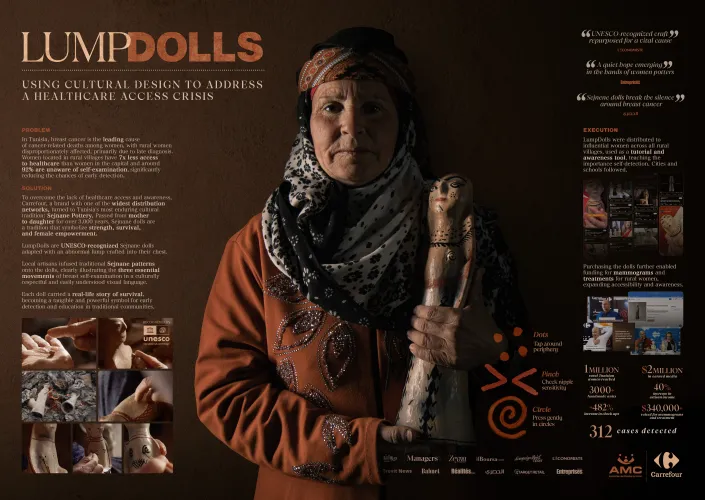
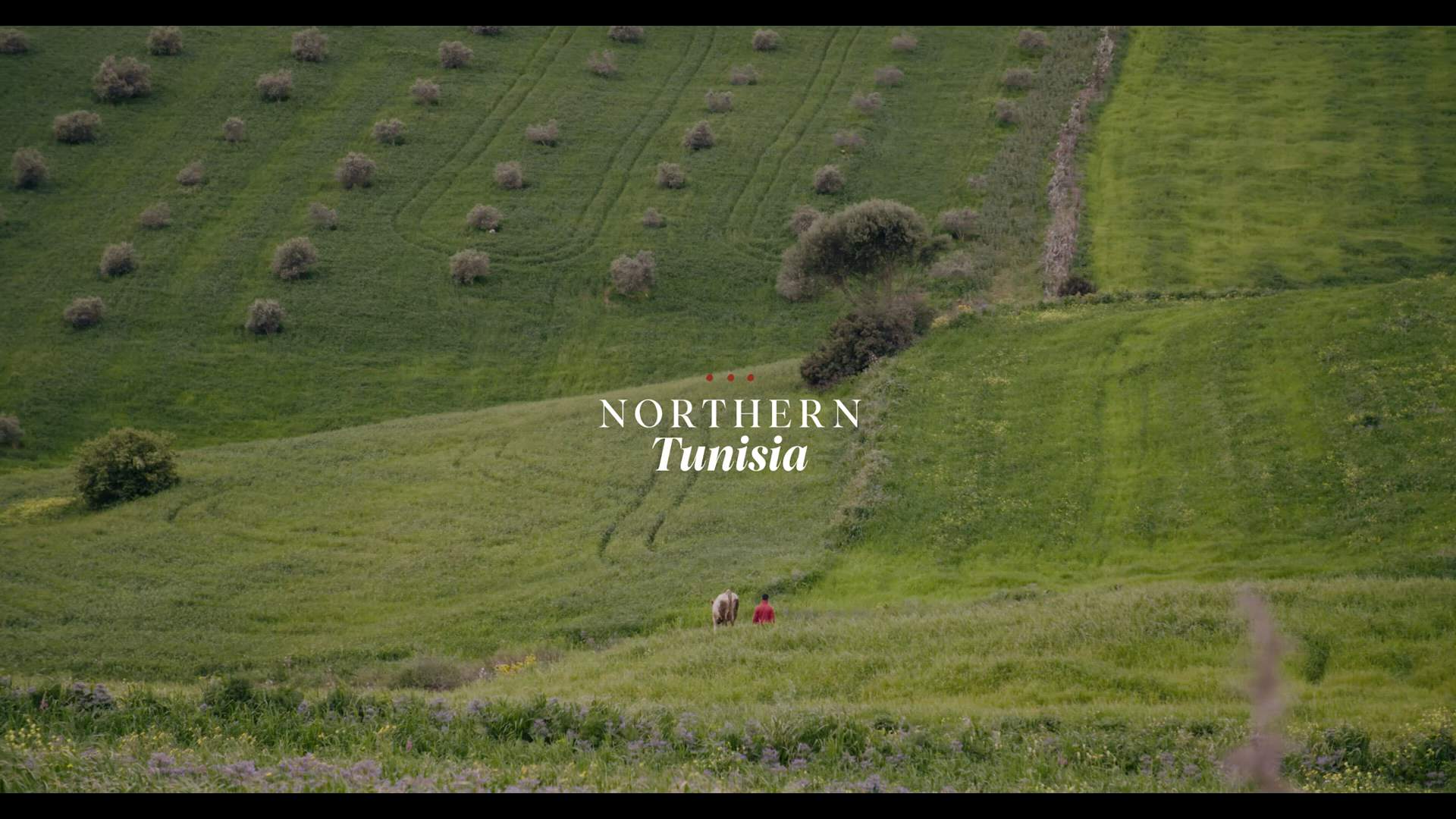
In the vast rural landscapes of Tunisia, women face a healthcare reality defined by isolation.
They live in areas where medical access is scarce - often facing a distance to a doctor that is seven times greater than that of a woman living in the capital.
This physical distance creates a critical gap in diagnosis for breast cancer, which remains the leading cause of cancer-related deaths among Tunisian women.
But the barrier is not just physical; it is deeply cultural.
A staggering 92% of these women do not know the risk factors or how to perform a self-examination.
Surrounded by generational taboos and silence, conversations about the female body are often forbidden, meaning that even if healthcare were closer, the knowledge to seek it is missing.
Carrefour Market recognizes that its role in Tunisia went beyond simple transactions; it has the power to be a vital infrastructure for social good.
While medical clinics stop at the city limits, Carrefour’s supply chain runs deep into the country’s most remote areas.
The brand identified a unique opportunity to use its scale to solve the access problem.
By leveraging one of the widest distribution networks in Tunisia, Carrefour could bring detection home.
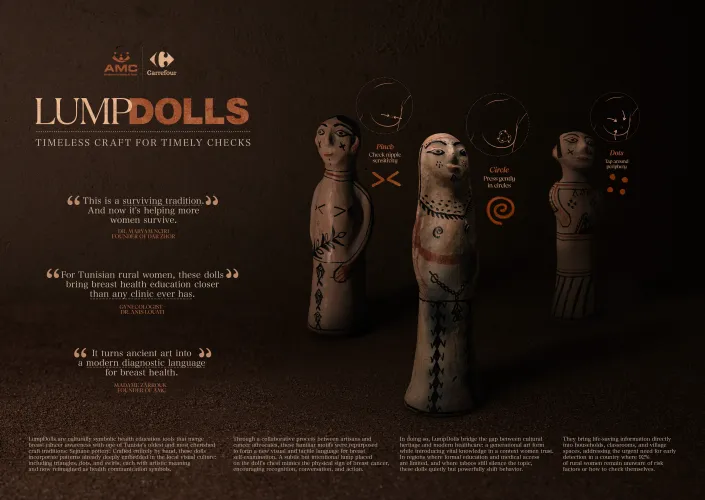
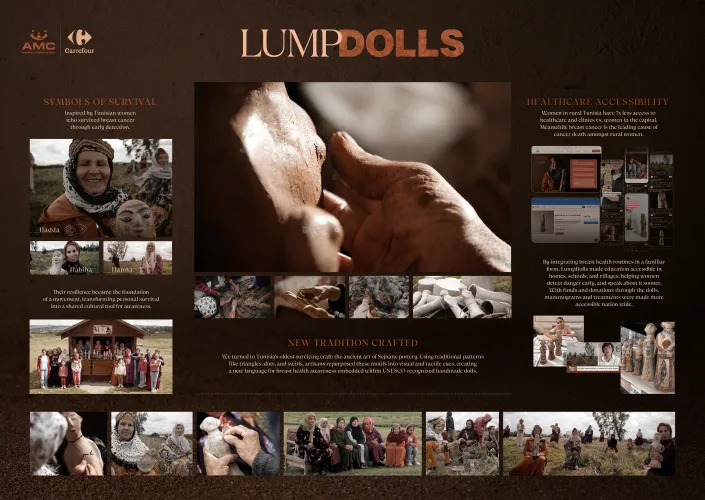
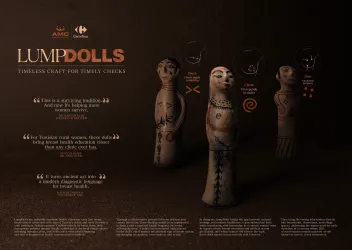
Research showed that 92% of rural women in Tunisia had no knowledge of breast self-exams. But they did know the Sejnane doll - a symbol of womanhood passed through generations. Instead of creating new language or visuals, the idea worked with what already held meaning.
Sejnane dolls have long existed in rural Tunisian homes as symbols of femininity and protection. So, we transformed a centuries-old object into a modern tool for health education.
Introducing: LumpDolls.
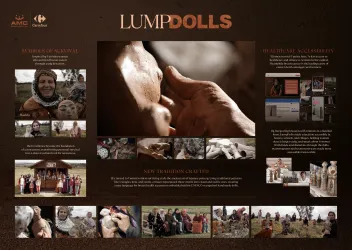
Rather than creating a new product or media campaign, we modified this existing object by adding a small lump on its chest and engraving intuitive Berber symbols to guide breast self-checks. There was no text or branding, only tactile cues that could be “read” through touch.
This approach didn’t just avoid cultural resistance - it turned tradition into a messenger. The dolls were trusted, familiar, and already part of daily life. Their transformation was quiet, but powerful.
Women didn’t need to be convinced to engage with the idea. It came into their homes in a form they already accepted. The idea reframed health awareness not as outside education, but as something inherited, personal, and within reach.
Credits
To see entry credits,
create an account
or
log in.
Logging in grants access to Advanced Search and more Entry Details.
Duplicate statues available now
Buy a Statue in
Direct
to Celebrate Your Team
Related Winners

Entrant Company
Korea Advertising Academy
Advertiser Category
Student
Category
Artificial Intelligence
Launch Country
South Korea

Entrant Company
Cheil PengTai Beijing & Cheil Hong Kong
Traditional Mediums
Advertiser Category
Consumer Brand Health Initiative
Medium
Digital / Mobile
Launch Country
China
Entrant Company
Cheil PengTai Beijing & Cheil Hong Kong
Traditional Mediums
Advertiser Category
Consumer Brand Health Initiative
Medium
Creative Use of Media
Launch Country
China
Film and TV
by David Gianatasio
by David Gianatasio

Gaming
by David Gianatasio
by David Gianatasio

2 Minutes With
by Shahnaz Mahmud
by Shahnaz Mahmud
Ad of the Week
by David Gianatasio
by David Gianatasio