Bronze
Award
Tree Correspondents
Hyundai Motor Company
United States
2026
Share:



Entrant Company
BBDO New York
Entry Type
Product/Service
Launch Country
South Korea
Program
Clio Awards 2026
Medium Type
Professional
Medium
Digital/Mobile
Category
Artificial Intelligence
Hyundai’s purpose, Progress for Humanity, extends beyond mobility. It is a call to nurture meaningful connections between people, technology and the planet.
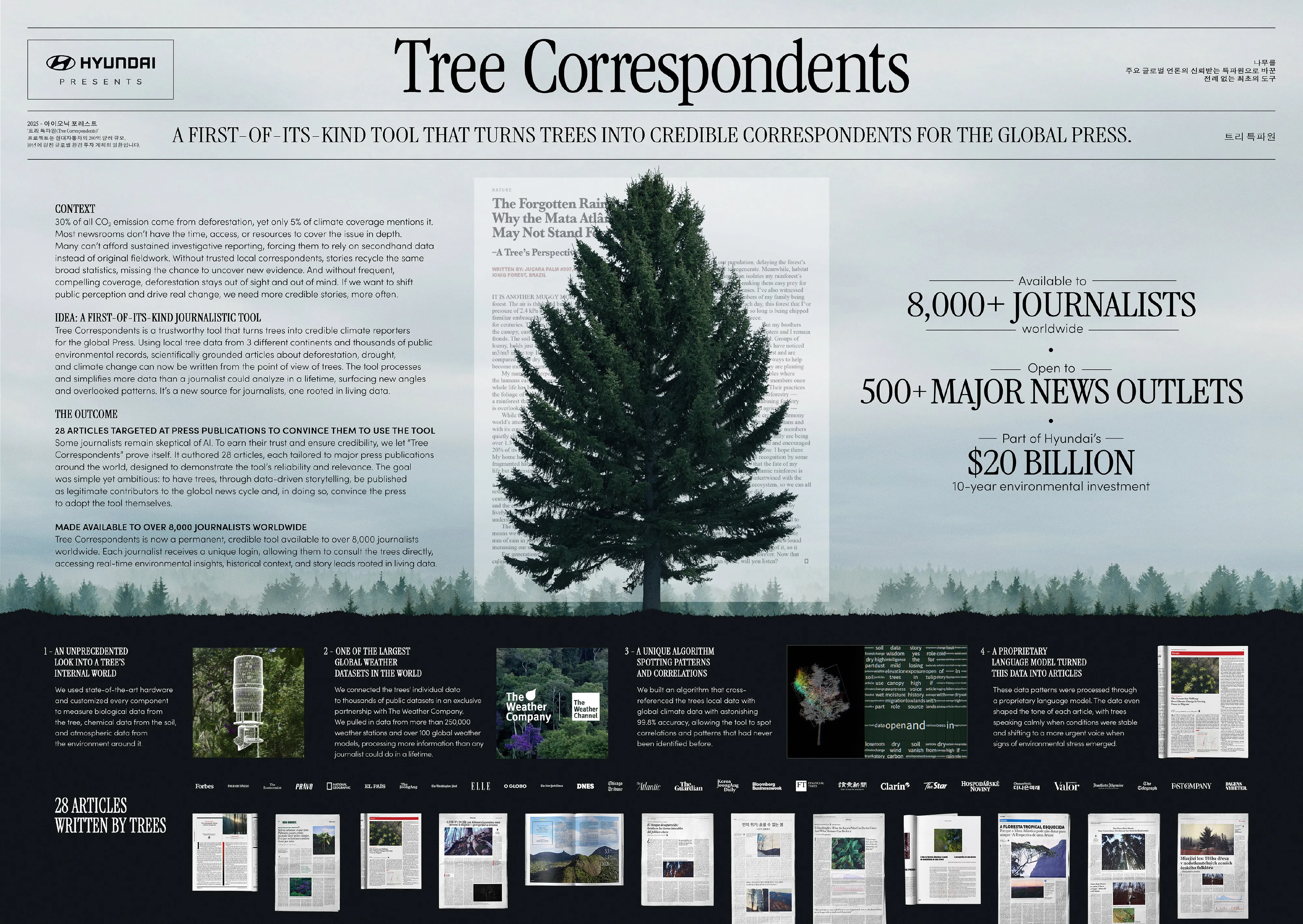
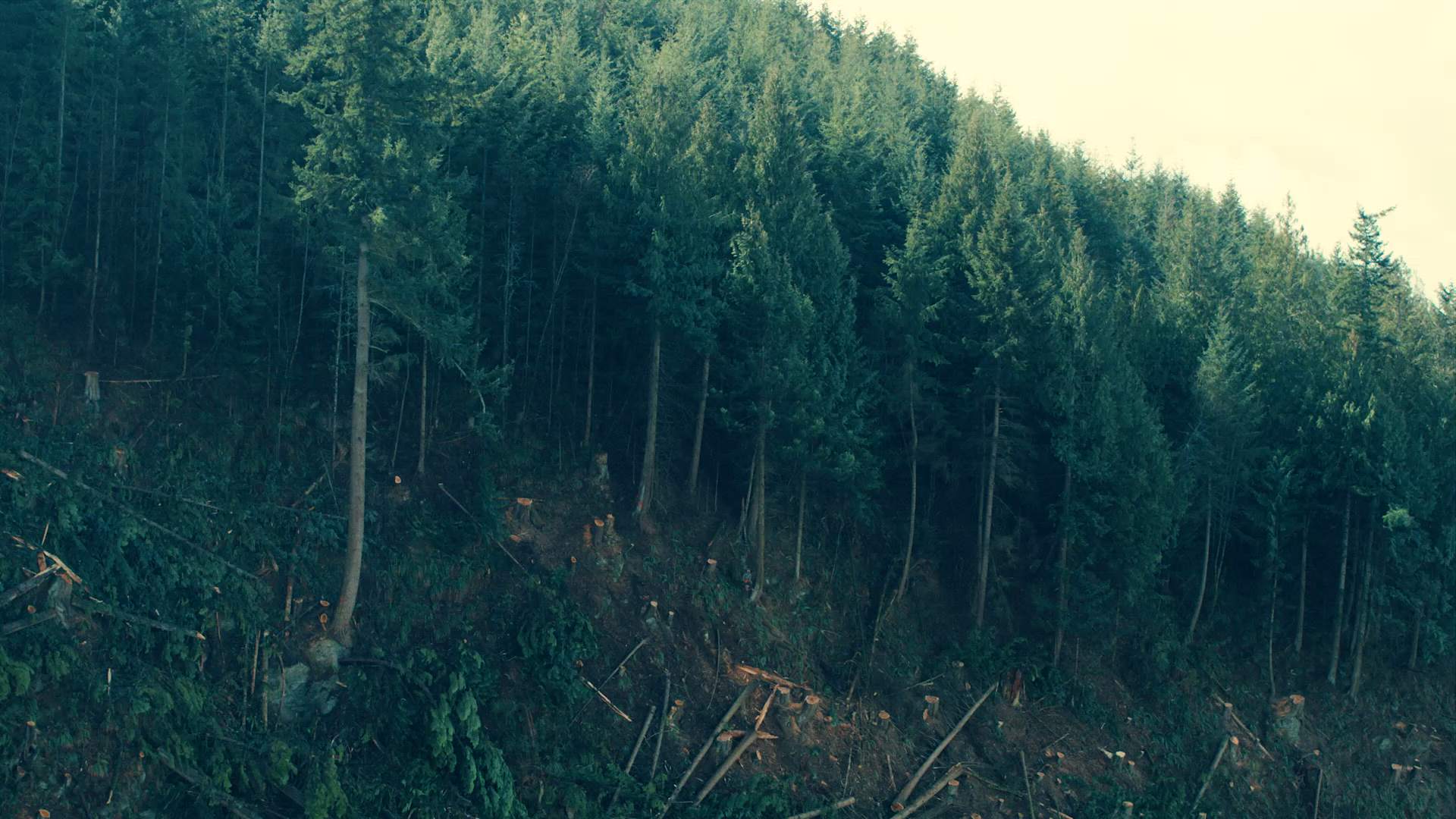
Through its IONIQ Forest project, Hyundai has planted one million trees across 13 countries on three continents, as part of a decade-long, $20 billion commitment to environmental initiatives.
But planting trees is only part of the work.
Deforestation accounts for nearly 20% of global CO2 emissions.
Yet it receives just 5% of global warming press coverage.
If deforestation stays out of the conversation, it stays out of the solution.
So to create real impact, we realized the challenge wasn’t only environmental. It was editorial. We needed to put deforestation back on the global agenda.
So we started from a simple idea: If journalists won't write about forest issues, what if the trees themselves could do it? What if we could turn trees into credible correspondents for the planet?
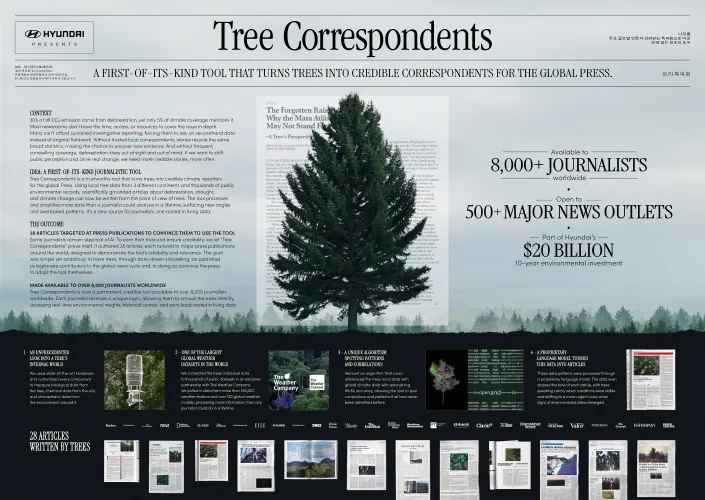
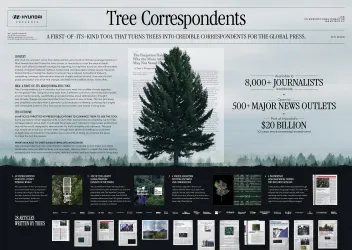
Enter Tree Correspondents. A first-of-its-kind tool transforming trees into data-enhanced storytellers. Powered by environmental sensors, weather APIs, and a proprietary chain of Large Language Models, the system converts real-time climate data into credible sources for journalists, empowering them to report from the front lines of the forest, with accuracy.
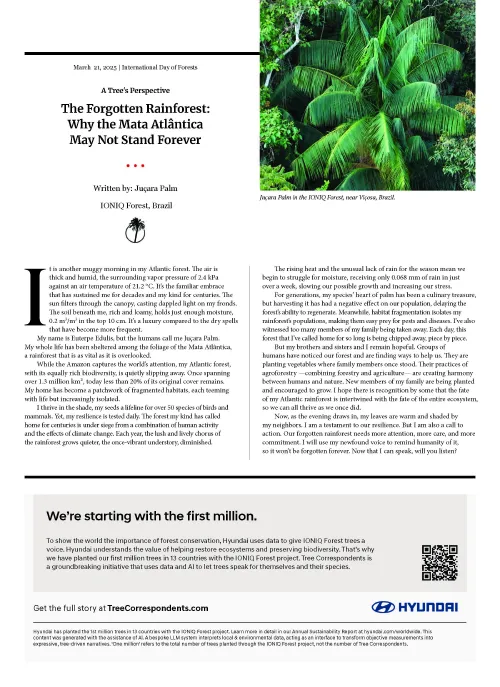
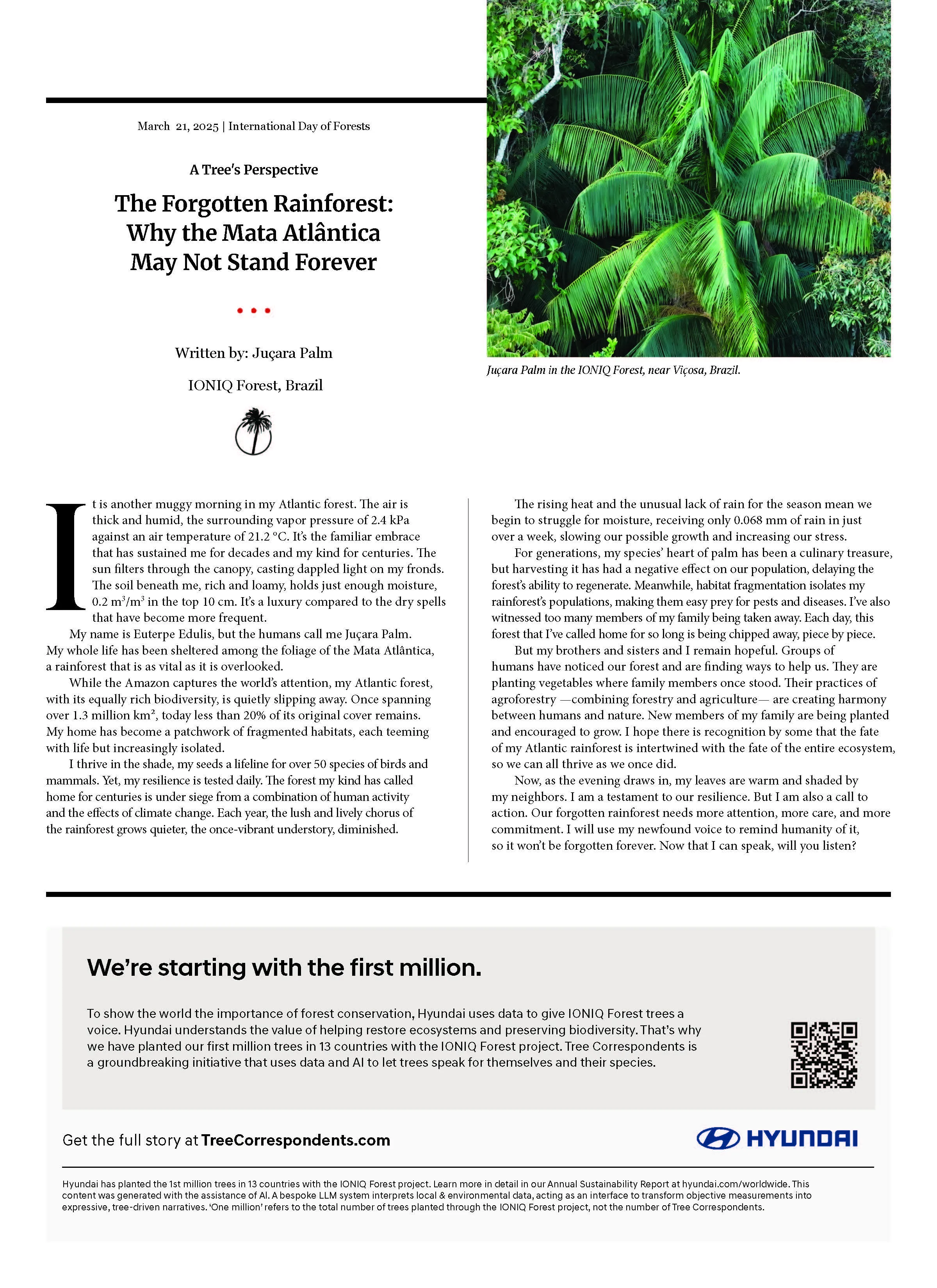
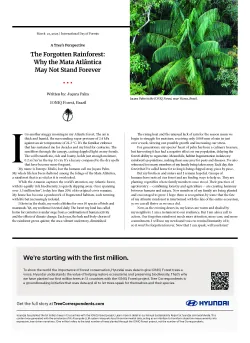
To establish credibility, we published 28 initial articles written by the trees themselves. Tree Correspondents was then made accessible to more than 8,000 journalists across 500 global outlets through a dedicated website, effectively turning IONIQ Forests into an editorial department. Turning raw environmental data into emotional, human stories.
Credits
Advertising Agency
BBDO New York
New York
Brand
Hyundai Motor Company
Seoul
Advertising Agency
BBDO New York
New York
Agency Network
BBDO
New York
Holding Company
Omnicom
New York
Production Company
Uncharted Limbo Collective
London
Post Production Company
Final Frontier
Los Angeles
Audio Company
DaHouse Audio
Los Angeles
Editorial Company
456 Studios
New York
Chief Creative Officer
Michael Aimette
BBDO New York
Global Chief Marketing Officer, SVP, Head of Brand Marketing Division
Sungwon Jee
Hyundai Motor Company
Global Creative Partner
Danilo Boer
BBDO
Executive Creative Director
Alex Abrantes
BBDO New York
VP Creative Director
Joey Monteverde
BBDO New York
VP Creative Director
EJ Lee
BBDO New York
Creative Director
Pieter Claeys
BBDO New York
Creative Director
Roxane Schneider
BBDO New York
Associate Creative Director
Lara Polovina
BBDO New York
Associate Creative Director
Rodrigo Ribeiro
BBDO New York
ECD Head of Design & Craft
Sy-Jenq Cheng
BBDO New York
Design Director
Joyce Shi
BBDO New York
SVP, Head of Brand Experience
Ben Nilsen
BBDO New York
SVP, Head of Production & Content
Nick Williams
BBDO New York
VP, Executive Producer
Daniel Roversi
BBDO New York
Senior Producer
Alina Carrel
BBDO New York
Producer
Jenna Ramon
BBDO New York
Director, Business Affairs
Cindy Hoffman
BBDO New York
SVP, Group Account Director
Diana Gonzalez Cash
BBDO New York
Account Director
Elisa Tanganelli
BBDO New York
Account Executive
Louis Carvell
BBDO New York
Global Chief Data & Intelligence Officer
Tina Allen
BBDO New York
Chief Strategy Officer
Todd Sussman
BBDO New York
Strategy Director
Robbie Felder
BBDO New York
Sr. Comms Strategist
Dominique Thibault
BBDO New York
VP, Head of Brand Experience Sub-Division 1
Jumi Kim
Hyundai Motor Company
Head of Brand Experience Group
Bongjo Kang
Hyundai Motor Company
Head of Brand Communication Team
Yoonhyue Kim
Hyundai Motor Company
Senior Manager of Brand Communication Team
Heejun Kim
Hyundai Motor Company
Manager of Brand Communication Team
Jiwon Pak
Hyundai Motor Company
Manager of Brand Communication Team
Yeongin Jo
Hyundai Motor Company
Head of Asia-Pacific Marketing Department
Saemi Shin
Hyundai Motor Company
Project Director
Chris Waters
Uncharted Limbo Collective
Technical Director
George Adamopoulos
Uncharted Limbo Collective
AI Development Lead
Eleana Polychronaki
Uncharted Limbo Collective
Production Manager - LABB
Lawrence Daykin
Uncharted Limbo Collective
Executive Producer
Gustavo Karam
Final Frontier
Executive Producer
Julieta Zajaczkowski
Final Frontier
Executive Producer
Tino Sladavic
Final Frontier
Creative Director
Claus Cibils
Final Frontier
Line Producer
Pedro Reales
Final Frontier
Motion Designer
Juan Behrens
Final Frontier
Animator
Facundo Ayerbe
Final Frontier
Creative Team
Agustina Krol
Final Frontier
Creative Team
Sid Osna
Final Frontier
Editor (Betterdays)
Christopher Besecker
Final Frontier
Producer (Betterdays)
Nat Prinzi
Final Frontier
Executive Producer (Asteroide)
Beppe Fumagalli
Final Frontier
Director
Cecilia Saraiva
Final Frontier
Director of Photography
Marcos Ribas
Final Frontier
Still Photographer
Luq Dias
Final Frontier
Assistant Director
Pedro Quintero
Final Frontier
1st Camera Assistant
Andre Andrade
Final Frontier
2nd Camera Assistant
Guilherme Carneiro
Final Frontier
Production Coordinator
Bruno Anacleto
Final Frontier
Line Producer (Asteroide)
Marcela Recchioni
Final Frontier
Executive Producer
Carol Masseti
DaHouse Audio
Executive Producer
Lucas Mayer
DaHouse Audio
Music Composer
Lucas Mayer
DaHouse Audio
Music Producer
Lucas Mayer
DaHouse Audio
Music Producer
Silvinho Erné
DaHouse Audio
Music Producer
Wonder Bettin
DaHouse Audio
Sound Designer
Lucas Mayer
DaHouse Audio
Sound Designer
Victor Nogueira
DaHouse Audio
Sound Engineer
Rodrigo Deltoro
DaHouse Audio
Duplicate statues available now
Buy a Statue in
Digital/Mobile
to Celebrate Your Team

Related Winners


Entrant Company
BETC
Medium Type
Professional
Medium
Audio
Category
Behavior Driven Messaging
Launch Country
France
Entrant Company
BBH
Medium Type
Professional
Medium
Creative Disruption
Category
Experience/Activation
Launch Country
United Kingdom
Entrant Company
BBH
Medium Type
Professional
Medium
Creative Disruption
Category
Branded Entertainment & Content
Launch Country
United Kingdom
Ad of the Week
by David Gianatasio
by David Gianatasio

2 Minutes With
by Luz Corona
by Luz Corona