

Bronze
Award
The Netherlands goes dark
Denk vooruit
Netherlands
2026
Share:




To see entry media,
create an account
or
log in.
Logging in grants access to Advanced Search
and more Entry Details.
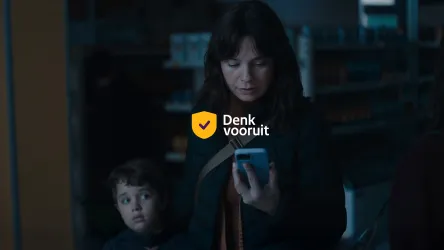
Entrant Company
Havas Lemz
Entry Type
Public Service
Launch Country
Netherlands
Program
Clio Awards 2026
Medium Type
Professional
Medium
Public Relations
Category
Single Market
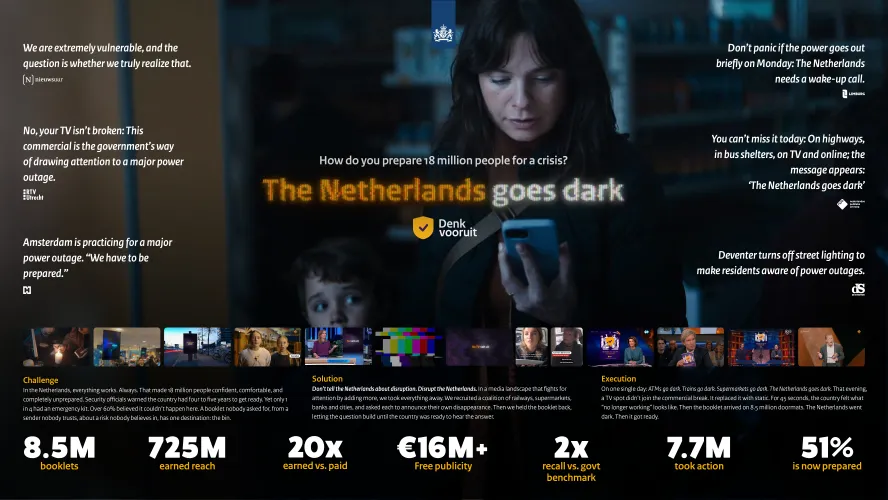
How do you prepare 18 million people for a crisis without causing one?
The Netherlands is one of the most connected societies on earth. Everything works, always. Which is precisely why no one imagines what happens when it doesn't. In late 2024, the Dutch government decided every household needed to survive 72 hours without power, water, or internet. An emergency preparedness booklet would go to all 8.5 million homes. The problem: a government brochure arriving without context ends up in the bin.
“The Netherlands Goes Dark” was designed to generate its own news cycle. Rather than push a government message through traditional PR, we built a campaign that society would participate in — and made that participation the story.
On November 17th, a coalition of dozens of organisations each announced their own hypothetical disappearance. The national railway showed “NS goes dark” on every platform screen. Over 400 supermarkets displayed the same on in-store screens. Banks and ATMs went dark. DOOH screens showed static and colour bars. Radio disruption spots broke through programming. Cities, schools, and households joined. That evening, every major talkshow covered the minister's introduction of the booklet — not because we pitched them, but because the country was already talking.
The booklet arrived the next day. Not cold. Not unexpected. It arrived in a country that was already talking.
Then the campaign escaped advertising entirely. The Sinterklaasjournaal — the Netherlands' biggest children's TV event, watched by millions — wrote preparedness into its storyline. Emergency kits became a popular corporate holiday gift. The comedian hosting the country’s New Year’s Eve broadcast built his special around it. None of this was paid for. The campaign had stopped being a government message and started being a national conversation.
The average government campaign is remembered by one in four. This was remembered by one in two. Earned media reached nearly twenty times the paid investment. Three quarters kept the booklet. And 43% of the Dutch population didn't just notice — they acted.
Sources: Verian-Validators Campaign Research 2025; Ipsos I&O Flitspeiling Jan 2026; HvdM PR Monitoring 2025.
Credits
To see entry credits,
create an account
or
log in.
Logging in grants access to Advanced Search and more Entry Details.
Duplicate statues available now
Buy a Statue in
Public Relations
to Celebrate Your Team

Related Winners


Entrant Company
BETC
Medium Type
Professional
Medium
Audio
Category
Behavior Driven Messaging
Launch Country
France
Entrant Company
BBH
Medium Type
Professional
Medium
Creative Disruption
Category
Experience/Activation
Launch Country
United Kingdom
Entrant Company
BBH
Medium Type
Professional
Medium
Creative Disruption
Category
Branded Entertainment & Content
Launch Country
United Kingdom

Fashion and Beauty
by David Gianatasio
by David Gianatasio
Fashion and Beauty
by David Gianatasio
by David Gianatasio
Fashion and Beauty
by David Gianatasio
by David Gianatasio
Clio Awards
by Luz Corona
by Luz Corona